

About
Ochs Labs

Low Energy Neurofeedback—a completely unique approach to brain optimization—was first introduced in 1990 by Dr. Len Ochs, Ph.D. After presenting his work at several national forums, Dr. Ochs founded Ochs Labs to further develop and refine the principles of Low Energy Neurofeedback and the technology that supports it.

Since then, LENS Providers and their clients have reported a wide range of positive outcomes using this innovative form of neurotherapy. More than 85% of individuals who have used LENS report significant benefits, with results often beginning in the first session and proving to be long-lasting.

Low Energy Neurofeedback System
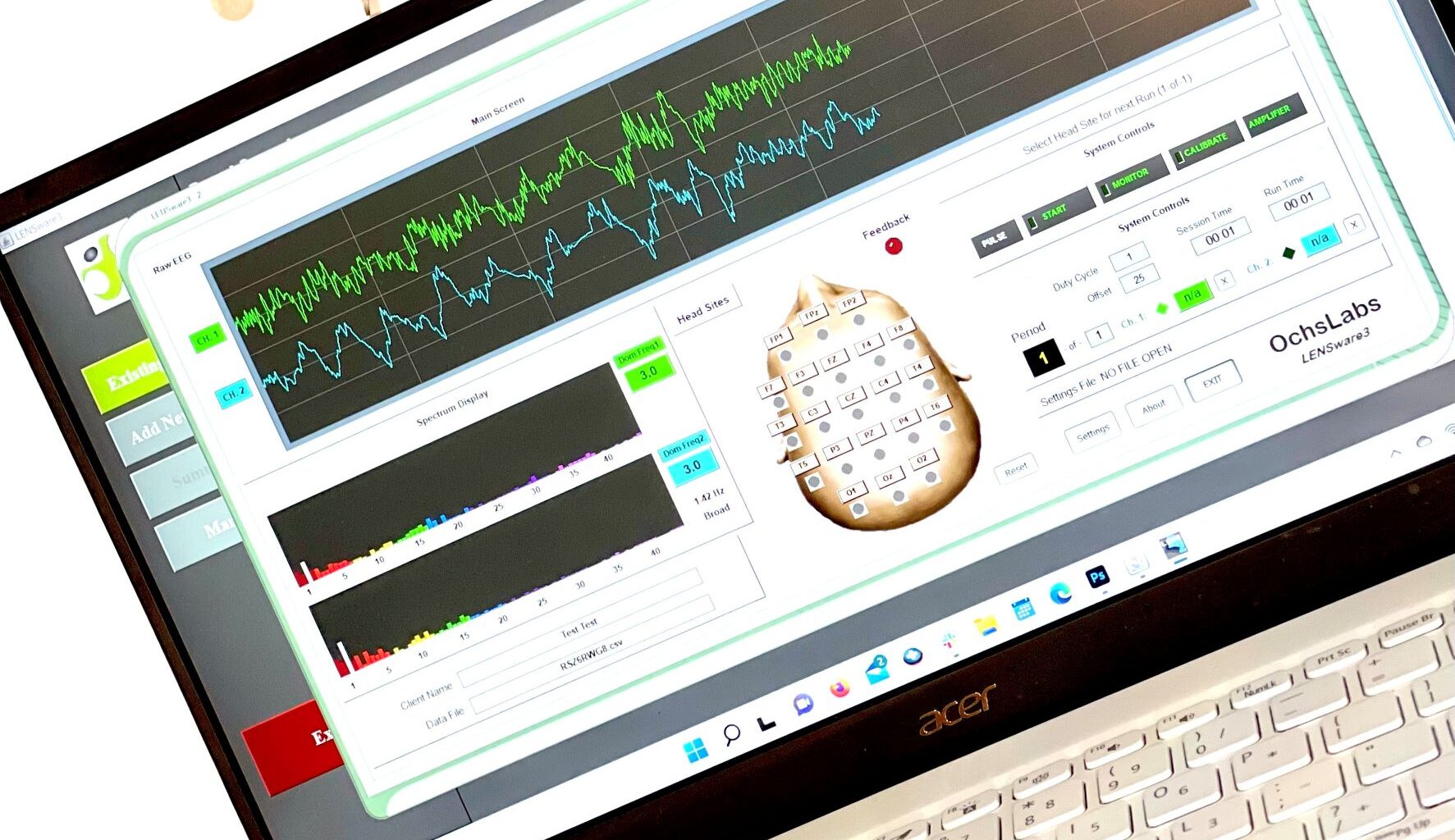
Traditional neurofeedback is a form of direct brain training, typically provided by licensed healthcare professionals, in which brain activity is monitored in real time and shaped through audio and visual operant conditioning.

LENS Neurofeedback is considered a non-traditional form of neurofeedback—also known as EEG biofeedback—because it works exclusively with the brain’s electrical activity (the electroencephalogram, or EEG) and does not rely on any audio or visual stimulation. Instead, LENS supports the brain’s natural ability to self-regulate.

Self-regulation is a foundational element of optimal brain performance, enabling the nervous system to function more efficiently and effectively.

LENS is a specialized form of neurofeedback that operates far more quickly than traditional neurofeedback and is particularly well suited for individuals who have difficulty sitting still. With LENS, the client does not need to actively participate or learn anything—the process is entirely passive. A typical LENS session lasts only 3–4 minutes, making it an effective option for individuals who may struggle to maintain attention on a computer screen for the extended periods required in traditional neurofeedback.

During a session, sensors are placed on the scalp to detect brainwave activity. This information is processed by proprietary software, which analyzes the client’s brainwave frequencies. Through a patented process, this information is then gently returned to the scalp via the sensors. The result is often a reduction—and in many cases, resolution—of symptoms that previously interfered with the client’s quality of life.

Each client’s EEG (brainwave) activity is unique and constantly changing. LENS continuously measures these dynamic signals and tailors the feedback to the client’s own neurological “fingerprint.”

The LENS software identifies the brain’s dominant frequency at any given moment—the frequency associated with the highest amplitude—and mirrors that information back to the brain. In essence, the brain receives a subset of the information it is already producing. The system monitors EEG activity in the 1–42 Hz range, filtering out frequencies above 42 Hz.

LENS sessions are brief—typically 3–5 minutes—and gentle, with most clients feeling little to nothing during the session. For many individuals, the benefits are lasting. However, in cases involving progressive or neurodegenerative conditions such as Parkinson’s disease or multiple sclerosis, ongoing sessions are generally needed to maintain improvements.

LENS is effective for a wide range of Central Nervous System–related challenges. These may include symptoms along the anxiety–depression spectrum, attention difficulties, behavioral disorders, sleep disturbances, headaches and migraines, PMS, and emotional regulation issues. LENS has also been used with organic brain conditions such as seizure disorders, autism spectrum conditions, and cerebral palsy. These challenges reflect underlying difficulties in the nervous system’s ability to self-regulate.

LENS may be used as a standalone therapy or as a complement to other treatment approaches. Individuals across the lifespan—from young children to older adults—have benefited from LENS. With over 30 years of use, it has been applied with infants as young as three months old and even with animals, including dogs, cats, goats, chickens, horses (including racehorses), chimpanzees, giraffes, and gorillas.


The timeframe for success with LENS is typically shorter than with other forms of neurofeedback, with most clients requiring approximately 9 to 11 sessions.

Unlike traditional neurofeedback, LENS:

  • Does not require conscious effort or sustained attention from the client
  • Involves very brief sessions, averaging from a few seconds to several minutes
  • Typically requires around 11 sessions when conducted on a weekly basis


To administer LENS sessions, you must hold an active professional license in the state or country where you intend to practice. Licensure requirements are governed by the regulations of the jurisdiction in which the license was issued. You may perform a simple search to confirm whether biofeedback or neurofeedback falls within your license’s scope of practice. If it does, you may become trained and listed as a LENS Provider upon successful completion of the LENS Foundations training.

If you are not licensed but wish to become a LENS Technician, you must work under the active license of a qualified healthcare provider in your area whose scope of practice includes biofeedback or neurofeedback. This licensed provider must agree to supervise your work, sign the LENS Technician Agreement, and allow you to operate under their license. The supervising provider is not required to be trained in LENS or hold any neurofeedback certification.

Examples of eligible licensed professionals include registered or licensed nurses, physicians, therapists, counselors, social workers, naturopathic doctors, physical therapists, and chiropractors (depending on the state’s scope of practice). 


Over 30 years of experience…

With over three decades of experience using LENS, we have developed a strong track record and high expectations for success in its application. Under typical circumstances, LENS neurofeedback is beneficial for nearly everyone. The human brain is inherently neuroplastic—designed to grow, adapt, and respond positively to cultivation and change.

Total Number of Patients helped
0
Average Number of Sessions
0
Average Min Per Session
0
D. Corydon Hammond, PhD., BCIA-EEG, ECNS
“In the last 17 years I have used 10 different neurofeedback systems. LENS is the most user friendly of the systems and produces the fastgest results, to the delight of my patients and myself. Many small children who struggle with or could not do traditional neurofeedback can easily be treated with LENS. It is the system I rely on. If there was a fire and I could only run out with one system, it would absolutely be the LENS. I highly recommend it. “

Allison Hartzoge, MA, BCN, LPC, NCC
“Ultimately, LENS neurofeedback relaxes the mind and body to allow the person to become aware of and process the underlying issues supporting addictions; then the healing process can begin. I believe it’s the most efficient and effective way to do therapy.”


Rano Thomas Mathew, M.D.

“I like the LENS because there are so many new ways in which it is used. Many changes have come about in the LENS software over the last five years, and I appreciate how the use of the LENS applications is continuing to be refined by Ochs Labs.”


Dr. Megan Danz

“Life can become simpler with LENS. For example, a gentleman I am working with has felt a much greater sense of clarity, ability to focus and set goals, and has been able to take himself through feelings of weakness successfully. He also has a greater sense of self respect and more realistic expectations of himself in general. Overall, he has been able to sift through the multi-layered facets of addiction with relative ease, and I think this speaks to his support network, his thoughtfulness, intelligence and the LENS.”

Marion Roberts, Ph.D.

“The results I’ve seen since using LENS with a wide range of clients (from emotionally handicapped children with ADHD, Fibromyalgia, anxiety, depression, the list is too long to enumerate) have far exceeded both my and my clients expectations! ”


Jeffrey S. Rutstein, Psy.D.

“I was astounded by the power and effectiveness of the LENS. I use it both alone and in conjunction with psychotherapy with uniformly positive results. I love the increased therapeutic effectiveness that the LENS offers. Not only has it reinvigorated my passion for my work, it has also been the single best investment in my practice I have ever made.”


Douglas L. Starr, Ph.D.

“I have been providing neurofeedback services for 14 years. Several years ago I acquired a LENS – to use along with my other units. To my complete surprise, I now use the LENS, and only the LENS, for about 70% of my clients, because it is more effective and efficient.”